Goddess Order Tier List: Best Characters for PvE and PvP
Building a team in Goddess Order is a little more complicated than simply grabbing three high-rarity characters and throwing them into battle. After spending time with different team setups, the biggest thing I noticed is that character value depends heavily on what you are actually trying to clear.
Some Knights are monsters in boss battles but feel slow when farming normal stages. Others are excellent at controlling enemies in PvP but do not bring enough sustained damage for longer PvE fights. Break potential, elemental synergy, Link Gauge generation, survivability, and tag-team compatibility all matter just as much as raw attack numbers.
That is exactly what this Goddess Order tier list focuses on. Instead of ranking characters only by rarity, I am looking at how useful they are in real teams, how difficult they are to build, and whether the resources spent on them continue to feel worthwhile later on.
If you are wondering which characters deserve your best relics, which DPS units should be upgraded first, or how to build a balanced PvE and PvP squad, this guide should give you a much clearer direction.
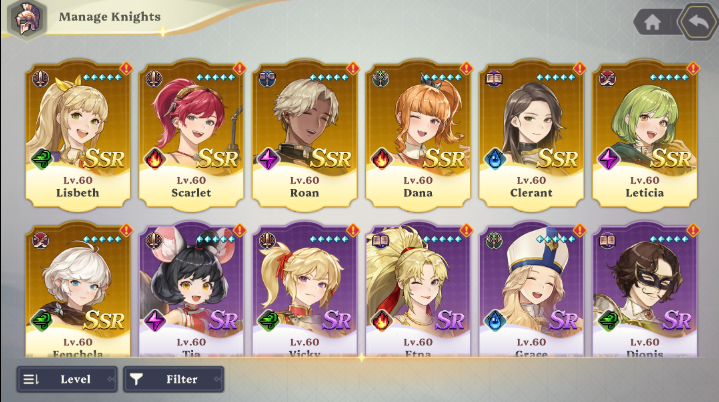
I. Goddess Order Tier List: Best Characters for PvE and PvP
A. Updated Overall Character Rankings
Here is my general ranking based on overall usability, damage potential, Break ability, support value, team flexibility, and performance across different battle types.
| Tier | Characters |
|---|---|
| SS Tier | Clerant, Scarlet, Roan, Fenchela |
| S Tier | Crea, Leticia, Luna, Siku, Dana, Lisbeth |
| A Tier | Violet, Grace, Gilbert, Dionis, Jan, Sibylla, Tia |
| B Tier | Sarah, Cathy, Etna, Aragon |
| C Tier | Vicky, Olivet |
This ranking should not be treated as an absolute rule. Goddess Order is heavily influenced by team composition and character investment.
A fully upgraded A-tier character that fits your element and rotation can easily outperform an SS-tier character that has poor equipment and no synergy with the rest of the squad.
That becomes especially noticeable with characters who gain major improvements from additional Unlock levels. Some Knights start out feeling average but become completely different once their passive effects and signature mechanics are strengthened.
B. How the Tier List Is Ranked
There are several things I look at before placing a character.
The first is damage consistency. I care more about damage that can realistically be delivered during normal gameplay than flashy theoretical numbers that require perfect conditions.
The second is Break performance. Breaking an enemy creates one of the safest opportunities to dump your strongest attacks, so a good Breaker can indirectly increase the damage of the entire team.
The third is team utility. Buffs, healing, crowd control, elemental debuffs, Link Gauge generation, and defensive tools can turn an average DPS character into something much more dangerous.
I also consider ease of investment. Characters who function well without requiring maximum duplicates or perfect relics naturally receive more value in an overall ranking.
Finally, PvE and PvP are judged separately. A character built to melt a stationary boss does not automatically become a top Arena choice.
II. Goddess Order Overall Tier List
A. SS Tier Characters
Clerant
Clerant is one of the most flexible characters in Goddess Order.
She brings meaningful damage while also contributing crowd control through Freeze. That alone makes her useful in several different team styles because she does not need to be your only damage dealer to justify taking a slot.
Against normal enemies, the control helps reduce pressure on your active character. Against tougher opponents, Clerant can continue dealing respectable damage instead of becoming dead weight after applying her debuff.
She is particularly valuable for players who prefer flexible characters instead of building completely separate rosters for every game mode.
Scarlet
Scarlet is probably the easiest high-level DPS recommendation to make.
Her ranged attacks give her a comfortable playstyle, while her Fire-based damage and piercing attacks make her effective against both individual enemies and clustered targets.
What I like most about Scarlet is that she does not need a complicated setup before she starts contributing. You can switch her in, establish your damage rotation, and immediately put pressure on the enemy.
She also works extremely well with Fire-focused supports, which gives her plenty of room to grow once you start creating more specialized teams.
Roan
Roan proves why Breakers are so valuable in Goddess Order.
Instead of judging him only by his personal damage, you need to look at what happens after he destroys the enemy's Break Gauge.
A well-timed Break lets your strongest attacker enter the field during a much safer damage window. That makes Roan indirectly responsible for a lot more damage than his own numbers might suggest.
He also brings solid survivability, which makes him forgiving when you are still learning difficult boss patterns or Arena matchups.
If you already own a strong DPS but your team still feels inconsistent, adding Roan can sometimes improve your overall performance more than summoning another attacker.
Fenchela
Fenchela is one of my favorite characters for single-target damage.
She is especially dangerous when the fight revolves around eliminating one priority enemy rather than clearing waves of smaller targets.
Her major weakness is that she does not feel as comfortable as Scarlet when dealing with groups. In boss battles, though, that matters much less.
Once properly invested, Fenchela can punish openings extremely hard, which makes her a natural choice for players who want to push boss damage or build burst-heavy PvP teams.
B. S Tier Characters
The S tier contains characters that are extremely strong but either have slightly more demanding setups or are more specialized than the SS group.
Crea is an excellent damage dealer, especially in PvE. Her offensive kit gives her strong boss potential and makes her a great choice for players building an Earth-centered team.
Leticia becomes dangerous once her Electric mechanics are properly established. She performs especially well when paired with teammates who help create time and resources for her rotation.
Luna is a flexible Slayer capable of handling both bosses and regular encounters. She requires more attention to skill timing, but experienced players can get excellent results from her.
Siku is one of the strongest Water-focused Breakers. She can help create Break windows while also improving the performance of a Water-heavy squad.
Dana is a fantastic offensive support. She works especially well with Fire attackers and can make already-powerful carries feel even stronger.
Lisbeth is another character who becomes noticeably better with investment. She may not immediately look like an endgame carry, but her progression can make her surprisingly dependable.
C. A Tier Characters
A-tier characters are good enough to build, especially when they fit your preferred element or team style.
Violet stands out because of her Link Gauge utility. She can make team switching smoother and help your strongest characters enter battle more frequently.
Grace provides useful support and can be valuable while building a newer account.
Gilbert offers defensive value and Break potential. He may not deliver the same offensive pressure as the best Breakers, but he can make difficult fights much safer.
Dionis becomes particularly useful in Wind compositions because his crowd control and debuff effects help prepare enemies for your primary damage dealer.
Jan, Sibylla, and Tia can all perform well when invested properly, but they generally require more specific situations to compete with the characters above them.
D. B and C Tier Characters
Characters in B and C tier are not automatically bad.
The bigger issue is efficiency.
When upgrade materials are limited, it is difficult to justify investing heavily in a niche character while more flexible options are available.
Etna, for example, can become quite useful in a dedicated Fire setup. If Scarlet is your main carry and you want to maximize Burn-related pressure, Etna becomes much more attractive.
Aragon can also provide value in the right Earth composition.
However, these characters usually need stronger team synergy before they feel impressive.
Vicky and Olivet can still clear content when properly built, but they are rarely my first recommendation for players trying to maximize limited resources.
III. Best Goddess Order Characters to Build First
A. Best Overall DPS Characters
If my account had limited resources, my DPS investment order would generally look like this:
Scarlet > Fenchela > Clerant > Crea > Leticia > Luna
Scarlet takes the first spot because she performs well in so many different situations.
Her range makes progression comfortable, her damage is easy to access, and she fits naturally into a strong Fire setup.
Fenchela becomes the better option when your priority is boss damage.
Clerant sacrifices some pure DPS in exchange for much better utility.
Crea is an excellent PvE choice, while Leticia and Luna become increasingly powerful once you learn how their individual mechanics work.
B. Best Support and Crowd Control Characters
For offensive support, Dana is one of the safest investments.
She can strengthen your main attacker rather than competing for field time, which is exactly what I want from a support character.
For crowd control, Clerant is excellent because Freeze can interrupt enemy pressure while still allowing her to contribute respectable damage.
Dionis is another useful option when you need enemy grouping or Wind-related support.
Violet deserves attention as well. Her value comes from making your tag-team rotation smoother instead of simply providing healing or raw attack buffs.
C. Best Breaker and Shield-Break Characters
If you only plan to heavily invest in one Breaker, I would choose Roan.
He combines strong Break pressure with enough defensive utility to stay useful even when things go wrong.
For Water teams, Siku is an excellent alternative because she fits naturally beside Water damage dealers.
Gilbert is another dependable choice for players who value survivability more than speed.
IV. Goddess Order PvE Tier List
A. Best Characters for Story, Farming, and Dungeons
PvE rewards consistency.
You usually want characters capable of handling multiple types of encounters without constantly rebuilding the team.
My general PvE tiers look like this:
SS Tier: Scarlet, Clerant, Crea, Roan
S Tier: Fenchela, Dana, Luna, Leticia, Siku, Lisbeth, Violet
A Tier: Grace, Jan, Tia, Gilbert, Dionis, Sibylla
B Tier: Sarah, Cathy, Etna
C Tier: Vicky, Aragon, Olivet
Scarlet is especially comfortable for everyday farming because she can attack safely from range and deal with grouped enemies without too much setup.
Clerant gives you more control.
Crea brings excellent offensive potential.
Roan makes harder encounters significantly easier by creating more reliable Break opportunities.
B. Best Characters for Boss Damage
Boss fights change the ranking because AoE becomes far less important.
This is where Fenchela really shines.
Her single-target specialization means almost everything she does contributes directly toward killing the boss faster.
Crea is another strong boss option because of her offensive scaling.
Scarlet remains excellent because she does not rely on a narrow gimmick to deal damage.
The important thing is to pay attention to boss mechanics. If a boss resists the status effect your team normally relies on, forcing that composition simply because the characters rank highly can produce worse results than switching to a lower-tier but better-matched squad.
C. Best PvE Team Compositions
Here are several team templates I like.
Fire Team: Scarlet + Dana + Etna
Scarlet handles most of the damage, Dana strengthens her offensive output, and Etna helps reinforce the Fire-oriented game plan.
Water Team: Luna + Siku + Clerant
Siku works on the Break Gauge, Clerant provides control and secondary damage, while Luna acts as one of the primary attackers.
Wind Team: Fenchela + Dionis + Lisbeth
Dionis can help prepare enemies for Wind damage while Fenchela focuses on eliminating priority targets.
Electric Team: Leticia + Roan + Violet
Roan creates Break opportunities, Violet helps the team's switching flow, and Leticia supplies the main offensive pressure.
These are not the only viable combinations, but they give each character a clear job instead of simply stacking three damage dealers together.
V. Goddess Order PvP Tier List
A. Best Arena Characters
PvP works differently because you have less time to establish long damage rotations.
Characters with burst, Break pressure, crowd control, and survivability become much more valuable.
My PvP ranking would look roughly like this:
SS Tier: Roan, Fenchela, Clerant, Lisbeth, Leticia
S Tier: Siku, Scarlet, Gilbert, Dionis, Sibylla, Cathy
A Tier: Luna, Dana, Jan, Aragon, Etna, Violet
Situational: Grace, Tia, Sarah, Vicky, Olivet
Roan is extremely annoying to fight because he combines Break threat and durability.
Fenchela becomes terrifying whenever she catches a vulnerable target.
Clerant brings control, which can interrupt the opponent's preferred rhythm.
Leticia can create explosive momentum when her team gives her enough time to establish pressure.
B. Best PvP Team Compositions
A strong Electric PvP setup is:
Leticia + Roan + Violet
Roan gives you frontline pressure, Violet supports the rotation, and Leticia provides burst.
Another interesting option is:
Fenchela + Dionis + Roan
This setup combines Wind-oriented pressure with a durable Breaker capable of creating openings for Fenchela.
For Water players:
Clerant + Siku + Luna
This team does not always explode immediately, but it offers a nice balance between control, Break pressure, and sustained damage.
C. PvP Meta: Burst, Control, and Survivability
Most PvP fights eventually come down to three things.
First, can you interrupt the opponent before they finish their combo?
Second, can you create a Break or control window?
Third, can your damage dealer finish someone before that opportunity disappears?
Burst matters because eliminating one enemy quickly changes the entire match.
Control matters because a frozen or interrupted character cannot execute their ideal rotation.
Survivability matters because even the strongest attacker is useless if they are eliminated before their setup begins.
That is why balanced teams usually perform better than lineups containing three fragile damage dealers.
VI. Goddess Order Reroll Guide
A. Best Reroll Characters
For players evaluating the strongest possible starting characters, my priority list would be:
-
Scarlet
-
Clerant
-
Fenchela
-
Dana
-
Leticia
-
Luna
-
Siku
Scarlet is the safest starting carry because she makes progression easier immediately.
Clerant gives you more flexibility across different team types.
Fenchela is fantastic for players who care about boss damage.
Dana becomes particularly valuable when paired with a powerful Fire attacker.
B. Best SSR Characters for Beginners
For a completely new player, Scarlet would be my first choice.
Her gameplay is straightforward, she has good range, and you do not need to master every advanced combat mechanic before she starts producing good damage.
Roan is another excellent beginner investment because strong Break pressure makes many difficult encounters more manageable.
Clerant is slightly more technical but offers excellent long-term flexibility.
C. Is Rerolling Worth It?
From a progression perspective, rerolling can be useful in games where starting with a strong SSR saves a large amount of upgrade material later.
However, rerolling is only worthwhile when the process is quick enough that you are not spending hours chasing a tiny improvement.
If you already have a strong carry such as Scarlet, Fenchela, Clerant, Crea, or Leticia, I would rather start progressing than endlessly restart for the theoretical perfect account.
VII. Goddess Order Team Building Guide
A. How Roles Work: Fighter, Slayer, Breaker, Supporter, and Trickster
Understanding roles is much more useful than memorizing tier placements.
Fighters are dependable attackers capable of staying active during regular combat.
Scarlet and Lisbeth are good examples.
Slayers generally lean toward high offensive pressure and burst damage.
Fenchela, Luna, Leticia, and Crea fit naturally into this category.
Breakers specialize in reducing the enemy's Break Gauge and creating safe windows for the rest of your team.
Supporters improve your squad through healing, buffs, resource generation, or other utility.
Tricksters tend to have more unusual mechanics, including debuffs, crowd control, status effects, and Link Gauge support.
A healthy team usually includes characters whose roles complement each other rather than three characters trying to perform exactly the same job.
B. Element Synergy and Tag-Team Combos
One of the biggest mistakes new players make is assuming that three high-tier characters automatically create a high-tier team.
Goddess Order rewards coordination much more than that.
The ideal rotation often starts with one character preparing the enemy, another character creating the Break window, and your main DPS entering afterward to unload their strongest skills.
Support effects can also become much more valuable when you switch immediately into a character capable of taking advantage of them.
Elemental synergy helps as well, especially when your team can stack related effects rather than each character applying something completely unrelated.
C. Best Fire, Water, Wind, and Electric Teams
Here are four simple elemental templates:
| Element | Team | Main Strategy |
|---|---|---|
| Fire | Scarlet + Dana + Etna | Buff Scarlet and build Fire pressure |
| Water | Luna + Siku + Clerant | Break, control, and sustained damage |
| Wind | Fenchela + Dionis + Lisbeth | Debuff enemies and burst priority targets |
| Electric | Leticia + Roan + Violet | Break enemies and accelerate tag-team rotations |
You do not always need three characters from the same element.
In many cases, a powerful universal Breaker or support character is more useful than forcing a weaker same-element Knight into the final slot.
VIII. Goddess Order Character Builds
A. Best Relics and Skill Upgrade Priorities
The biggest build mistake is spreading resources evenly across every character and every skill.
Your main carry should receive priority.
For DPS characters, focus first on the skill or passive that drives their main damage rotation.
For Breakers, invest in abilities that increase Break efficiency and survivability.
For supports, prioritize the buff, healing, or resource mechanic that directly benefits the rest of the party.
A simple upgrade order looks like this:
Core character mechanic > Main damage or support skill > Break or Link utility > Secondary skills
Relics should follow the same logic.
Do not equip something only because it gives a higher overall stat number. A relic that strengthens the exact mechanic your character uses can often provide significantly more practical value.
B. Which Characters Are Worth Investing In
If I were trying to avoid wasting resources, these would be my safest choices.
Scarlet is worth building for consistent PvE damage.
Roan is worth building because Break utility remains useful regardless of which attacker you use.
Clerant offers both control and damage.
Fenchela is excellent for boss-focused players.
Dana strengthens powerful carries rather than competing with them.
Crea is a strong offensive investment for Earth teams.
Leticia works well as an Electric carry.
Siku is especially useful for Water-focused rosters.
The other thing to remember is that character Unlock level matters enormously.
A heavily invested lower-tier character can easily outperform an unbuilt SS-tier unit.
That means you should always look at your actual account instead of blindly copying somebody else's tier list.
IX. Goddess Order Tier List FAQ
A. Who Is the Best Character in Goddess Order?
There is no single Knight that dominates every type of content.
For general progression, I would choose Scarlet.
For versatility, Clerant is one of the strongest options.
For Break utility, Roan is extremely valuable.
For single-target boss damage, Fenchela is one of my favorite choices.
If you already have one of these characters properly invested, you usually do not need to chase another top-tier unit immediately.
B. Which Characters Are Best for PvE and PvP?
For PvE, my favorite options include:
Scarlet, Clerant, Crea, Fenchela, Dana, Luna, Roan, and Siku.
For PvP, I place more value on:
Roan, Fenchela, Clerant, Lisbeth, Leticia, Siku, Gilbert, and Dionis.
PvE favors reliable damage and efficient rotations over longer fights.
PvP gives much more importance to burst damage, control, Break pressure, and survivability.
C. Which Character Should New Players Choose First?
My first recommendation is Scarlet.
She offers good range, strong damage, straightforward gameplay, and excellent Fire synergy.
You can use her effectively without mastering every advanced mechanic immediately, but she still has enough potential to remain useful after you understand the combat system more deeply.
If Scarlet is not available, Clerant is another excellent starting choice.
Players who already have a good DPS should consider investing in Roan, because a reliable Breaker can improve almost every team you build.
Let's wrap things up
The most important thing to understand about this Goddess Order tier list is that individual rankings only tell part of the story.
Goddess Order rewards players who understand how Break timing, elemental interactions, crowd control, Link Gauge generation, switching, and support effects work together.
A team containing three powerful attackers may look impressive on paper, but it can easily perform worse than a balanced lineup built around one carry, one Breaker, and one support or utility character.
For general progression, Scarlet is still one of the easiest characters to recommend because she combines strong damage with comfortable ranged gameplay.
For boss encounters, Fenchela brings excellent single-target pressure.
For Break-focused teams, Roan is extremely dependable.
And if you want one character capable of contributing across several different situations, Clerant is difficult to ignore.
Rather than chasing every high-tier character, choose one main damage dealer, build a team that supports that character properly, and invest deeply instead of spreading resources across your entire roster. In Goddess Order, a well-built team with strong synergy will almost always feel better than three random characters chosen only because they sit near the top of a tier list.